Animal Habitats
Where do animals live, and why?
Duration: 1:55
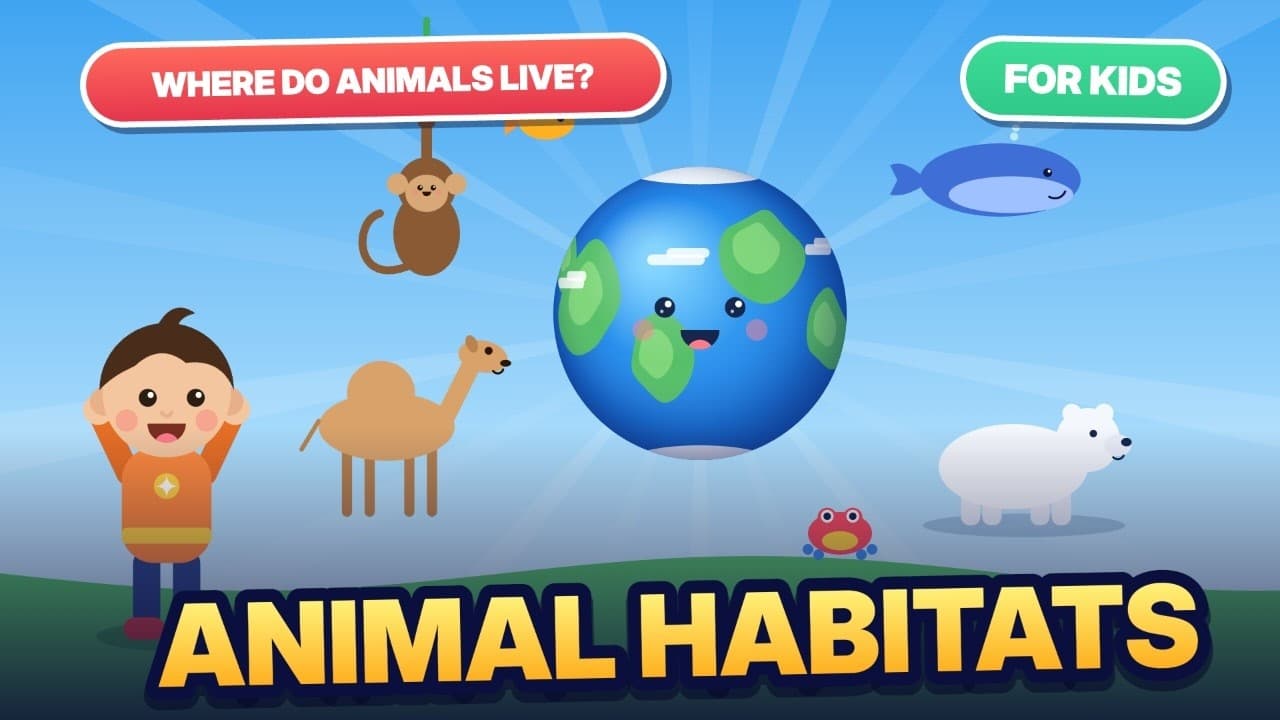
Where do animals live, and why? Join our little explorer on a trip around the world to visit animal homes!
In short
Every animal lives in a special place with the food, water, and shelter it needs: this home is called a habitat. The desert is hot and dry, with very little water; a camel can walk for days without drinking, and it stores fat in its hump. The ocean is huge and salty; fish breathe underwater with gills, and whales and dolphins swim up to the top to breathe air. In the forest, tall trees give food and shelter: squirrels collect nuts, and owls sleep in tree holes during the day. The Arctic is cold and icy; polar bears have thick fur and a layer of fat to stay warm. The rainforest is warm and rainy and full of plants; monkeys swing from tree to tree, and colorful frogs hide on the leaves. Each animal has special body parts that help it live in its habitat: a camel could not live in the Arctic, and a polar bear would be much too hot in the desert. When we keep habitats clean and safe, we help the animals that live there.
What you will learn
- What a habitat is: a home with food, water, and shelter
- The desert, and how a camel stores fat in its hump
- The ocean: fish with gills, and whales and dolphins that breathe air
- The forest: squirrels, nuts, and sleepy owls
- The Arctic: polar bears with thick fur and a layer of fat
- The rainforest: swinging monkeys and colorful frogs
- Why each animal has special body parts for its habitat
Let's talk about it
Questions to ask after watching, at home or in class. Tap a question to see a short answer.
What three things does every habitat give an animal?
Food, water, and shelter.
How does a polar bear stay warm?
With thick fur and a layer of fat.
Why could a camel not live in the Arctic?
Its body is made for the hot, dry desert, not for the cold.
What the narrator says
Everything the narrator says in the video, to read along, to practice English, or to use in class.
Read the full text
Hello again, little explorer! Today, we are going on a trip around the world, to visit animal homes!
Every animal lives in a special place, with the food, water, and shelter it needs. This home is called a habitat. But why do animals live in different places? Let's find out!
First stop: the desert! It is hot and dry, with very little water. A camel can walk for days without drinking, and it stores fat in its hump.
Next stop: the ocean! It is huge and salty. Fish breathe underwater with gills, and whales and dolphins swim up to the top to breathe air.
Now, the forest! Tall trees give food and shelter. Squirrels collect nuts, and owls sleep in tree holes during the day.
Brrr! Welcome to the Arctic! It is cold and icy. Polar bears have thick fur and a layer of fat to stay warm.
And now, the rainforest! It is warm and rainy, and full of plants. Monkeys swing from tree to tree, and colorful frogs hide on the leaves.
Each animal has special body parts that help it live in its habitat. A camel could not live in the Arctic, and a polar bear would be much too hot in the desert!
When we keep habitats clean and safe, we help the animals that live there.
So now you know the secret! A habitat is an animal's home, with everything it needs to live.
What is your favorite habitat? Great job, little explorer! See you next time, for a new adventure at Curious Kids Lab!